
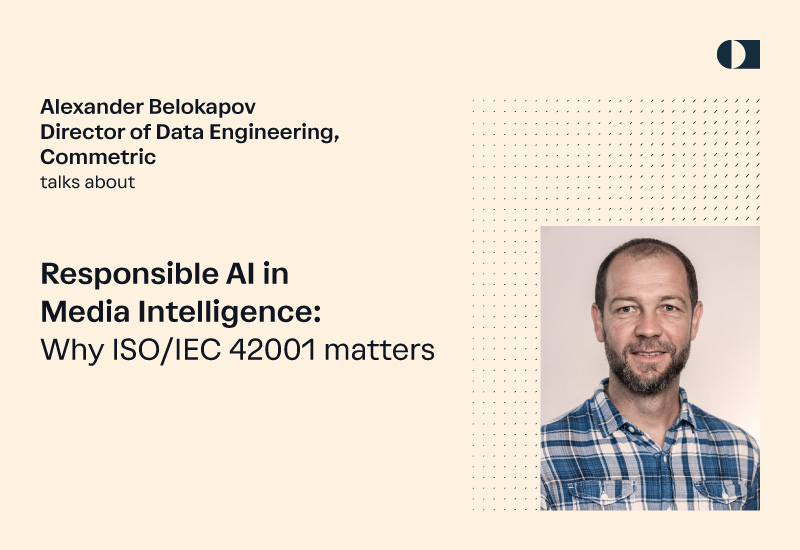
A Q&A with Commetric’s Director of Data Engineering, Alexander Belokapov
Artificial intelligence is rapidly transforming how organisations analyse media narratives, reputational risks, and stakeholder influence. But with growing AI capabilities comes the need for clear governance, transparency, and accountability.
Commetric recently achieved certification for ISO/IEC 42001:2023, the first international standard dedicated to AI Management Systems (AIMS).
We spoke with Alexander Belokapov, Director of Data Engineering at Commetric, about why this certification matters – and how it reinforces the company’s approach to responsible AI in media analytics.
Q: What is ISO/IEC 42001 and why is it important for AI-driven analytics?
Alexander Belokapov:
ISO/IEC 42001 is the first international standard specifically designed to help organisations establish structured governance for AI systems.
It provides a framework for:
- Responsible AI governance
- Risk management and accountability
- Transparency in AI-driven decision systems
- Continuous monitoring and improvement
In industries like media intelligence, AI is used to process vast volumes of information and extract insights that inform strategic decisions. That makes trust, reliability, and oversight essential.
Achieving ISO/IEC 42001 certification demonstrates that our AI systems are not only powerful – they are also managed responsibly and transparently.
Q: Why did Commetric pursue ISO/IEC 42001 certification now?
Alexander Belokapov:
AI and large language models are evolving extremely quickly.
In media analytics, AI is already central to analysing global news coverage, detecting emerging narratives, and identifying reputational risks. But regulation and governance frameworks are still catching up.
We started the certification process in 2025 because we anticipated that AI governance will become a core expectation for analytics providers.
By achieving ISO/IEC 42001 early, Commetric is proactively setting the standard for responsible AI in media intelligence.
Q: How does AI actually power Commetric’s analytics solutions?
Alexander Belokapov:
Our analytics ecosystem is built around SieraPlex, our proprietary knowledge graph that transforms unstructured news into structured business intelligence.
SieraPlex continuously processes global media coverage and extracts structured business events – things like litigation, executive changes, operational disruptions, or regulatory decisions.
Each event is linked to companies, industries, and market data, enabling deep analysis of how media narratives evolve and affect business outcomes.
This structured event detection allows our platforms to move beyond simple keyword monitoring toward real intelligence about what is actually happening in the business environment.
Q: What makes SieraPlex different from typical AI media monitoring systems?
Alexander Belokapov:
Most media monitoring systems rely heavily on keyword search or statistical NLP models. That often creates noise and misses the deeper meaning of events.
SieraPlex takes a fundamentally different approach.
At its core is SiFT – our proprietary event extraction engine, which identifies over 440 distinct business event types across corporate activity.
This system was built over 130 person-years of development, making it one of the most advanced event-detection frameworks in the industry.
Because events are structured and linked to companies and industries in a knowledge graph, we can analyse:
- Risk frequency and severity
- Media narrative dynamics
- Investor sentiment signals
- Competitive developments
The result is structured, strategic intelligence – far beyond simple media monitoring.
Q: How does responsible AI governance apply to systems like SieraPlex?
Alexander Belokapov:
Responsible AI isn’t just about the algorithms themselves – it’s about the entire lifecycle of the system.
ISO/IEC 42001 requires organisations to implement governance frameworks covering:
- AI model oversight
- risk management processes
- traceability and auditability
- continuous system monitoring
For SieraPlex, this is particularly important because the infrastructure operates at massive scale – extracting tens of millions of business events every year from global media sources.
Certification confirms that our AI infrastructure operates under clear governance, controls, and accountability mechanisms.
Q: What benefits does this bring to communications and corporate strategy teams?
Alexander Belokapov:
Communications leaders today face enormous information overload.
Every day there are thousands of articles, social posts, and stakeholder narratives that could affect a company’s reputation or valuation.
Our goal is to turn that chaos into structured, decision-ready intelligence.
For example, our Personalized Media Briefing uses SieraPlex to automatically generate role-specific insights for executives, highlighting the most relevant business events affecting their organisation.
That means leaders can quickly see:
- emerging risks and crises
- competitor developments
- regulatory or legal signals
- investor-sensitive events
When these insights are powered by responsibly governed AI systems, decision-makers can trust the intelligence they are using.
Q: How does ISO/IEC 42001 reinforce trust in AI-powered analytics?
Alexander Belokapov:
Trust is becoming the defining factor in AI adoption.
Organisations want powerful AI tools – but they also want assurance that these tools are transparent, accountable, and ethically managed.
ISO/IEC 42001 certification shows that:
- AI systems are governed responsibly
- risks are actively managed
- processes ensure transparency and oversight
- innovation happens within a clear ethical framework
For our clients, this means they can rely on our analytics to support high-stakes decisions in communications, reputation management, and corporate strategy.
Q: What does this certification say about Commetric’s broader approach to AI?
Alexander Belokapov:
It reflects something that has always been part of our philosophy.
At Commetric, we combine advanced AI technologies with human expertise.
AI helps us process enormous datasets and identify patterns that would be impossible to detect manually. But human analysts and engineers guide the design, governance, and interpretation of those systems.
Achieving ISO/IEC 42001 certification reinforces that commitment: delivering AI-driven insights that are not only powerful – but responsible, transparent, and trusted.